⏱️ Reading Time
7 min
📅 Publication Date
📝 Abstract
The second edition of the AlgoVerde Consumer Pulse reveals why national averages can obscure critical consumer realities. Using AI-powered consumer personas, this research uncovers emerging behavioral shifts across income segments and explores how brands can make faster, more informed decisions in rapidly changing economic conditions.
Market Research
Consumer Research Needs to Move as Fast as the Market Does. AI Makes That Possible.
A 54% national average is both accurate and useless. The AlgoVerde Consumer Pulse explains why.
If you check any standard survey right now, you’ll find that 54% of US consumers say gasoline has had a significant or major impact on their household budget. That figure is statistically accurate but analytically misleading: it folds together two consumer populations with almost nothing in common.
Among lower-income, vehicle-dependent consumers, or the Americans who need a car to get to work, 82% report significant or major budget impact from gas prices. Among upper-income consumers, surveyed the same week, the figure is 3%. That’s a 78-point spread.
These two groups are not experiencing the same economy. Any brand strategy built on the national average is flying blind.
How we discovered this insight, and why the numbers hold up
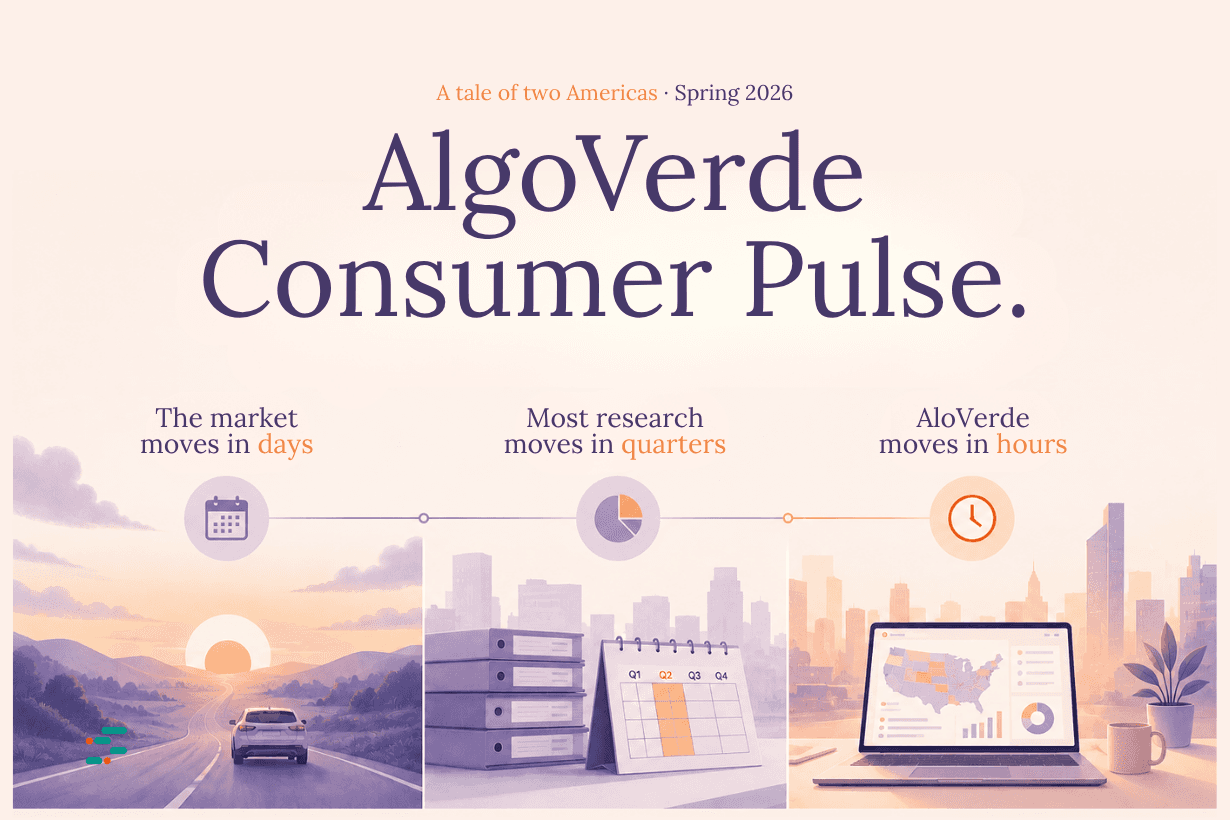
These findings come from the second edition of the AlgoVerde Consumer Pulse, a quarterly consumer research based on an AI methodology that produces reliable results in hours rather than weeks.
A standard consumer research study takes weeks to design, recruit, field, and analyze, and costs thousands of dollars, up to $200,000. That timeline and that budget are now beyond reach for most brand managers. The Hormuz shock arrived at the pump in early March, and consumer confidence hit a historic low by late April, less than six weeks later. Any study commissioned in February, however well-designed, would have been outdated by the time it was out.
AlgoVerde’s approach produces results in hours and is just as reliable. It is built around AI Personas: AI-powered replicas of structurally distinct consumer segments, defined by the factors that actually drive behavior: income, employment type, debt load, geography, housing situation, and media environment.
The Spring 2026 study covered 22 questions across six topics against a verified snapshot of current economic conditions (gas at $4.257/gallon, MCSI at 49.8, weekly jobless claims at 189,000, fed funds rate at 3.50–3.75%).
Every question runs three times independently. Numbers that hold within five percentage points across all three runs get published as hard figures. Numbers that don’t get published as ranges or with explicit caveats. Numbers that can’t be reconciled with real-world data from CBS/YouGov, Gallup, the Conference Board, Marist, the University of Michigan, the BLS, and the Fed, don’t get published at all.
The 82% segment-level gas impact figure — the headline finding of this edition — moved by just one percentage point across all three runs.
How we validated this approach
The methodology behind the Consumer Pulse isn’t new to us. In 2024, AlgoVerde ran a formal validation study in partnership with a leading US consulting firm: taking a real, fielded consumer sentiment survey orchestrated yearly by this global consulting firm and replicating it using a fully synthetic panel of 2,100 virtual participants created by AlgoVerde to represent the US population.
The results mirrored the original study closely enough to be actionable. The rank ordering of economic concerns was essentially identical. The behavioral patterns — where consumers cut, what they protected, how they managed their budgets — tracked with the real panel. The synthetic results diverged only at the margins of very granular subcategory questions, and even there the direction of the findings held.
The conclusion: AlgoVerde’s AI-driven consumer research, done with structural rigor, is not a shortcut. It’s a different mode of doing the same work, faster, more frequent, and at a fraction of the cost.
Consumer behaviors have already changed
What makes this finding relevant for brands is that 83% of US consumers have already made at least one concrete change in response to fuel costs. They are consolidating trips (58%), cutting dining out (48%), canceling travel (42%), and pulling back on non-essentials across a range of categories. This isn’t what they plan to do, it’s what they’ve already done.
Sentiment, as a rule, leads spending by one to three months. The April record low shows up in May and June spending data. Brands planning off Q1 assumptions are already behind. They need real-time data.
What this means for brands right now
For any brand whose customer base spans income segments — meaning, nearly every major CPG brand in the US — the AlgoVerde Spring 2026 Consumer Pulse points to some uncomfortable realities.
First, any national average is a liability now, not a strategy. The pricing, packaging, and promotions that work for upper-income consumers won’t work for lower-income ones, and vice versa.
Demand destruction is not coming, it is already here. Dining out is already down 48%. Travel cancellations are at 42%.
The “employed but anxious” consumer is the most important consumer right now. Over 63% of Americans feel secure in their jobs. They have the income to spend , but not the conviction.
Some consumers have run out of room to adapt. Fixed-income retirees have already cut everything they can cut.
How you can use this research
This is the second edition of the AlgoVerde Consumer Pulse. We plan to publish one every time economic conditions face a major disruption.
Our goal is not to produce a report. It is to give brands a quick read on conditions that doesn’t arrive the quarter after they needed it; so they can test, simulate, validate.
While we recognize that AI Personas are still a relatively newcomer on the survey scene, and not everybody is convinced of their effectiveness, we believe there’s enough evidence that points to their reliability (within and beyond our own proprietary methodology). All our customers initially ran validation studies at first, and all of them came away convinced. Synthetic panels are more than a fad and more than a trend at this point. They are a valid alternative to traditional research, and a reality for many innovative companies.
Elisabetta Ghisini is CMO and Co-Founder of AlgoVerde, an AI-powered innovation platform. The full AV Consumer Pulse Spring 2026 report, including the methodology note and segment-level data, is available at algoverde.ai.